Posts

Generative-AI

  Generative-AI Generative AI, a cutting-edge technology, has revolutionized various industries by enabling machines to create content that resembles human-generated work. It encompasses a wide range of applications, from text generation to image synthesis and even music composition. After mastering generative AI, individuals can pursue exciting job roles in fields such as artificial intelligence research, data science, and creative industries. The ever-expanding applications of generative AI promise a bright future for those who master this technology, offering opportunities to shape how we interact and create content in the digital age. Some of the top job roles include: AI Researcher, where you can delve deep into the development of advanced generative models Data Scientist, using generative AI to extract valuable insights from data Content Creator, harnessing generative AI for innovative storytelling AI Ethics Consultant, addressing the ethical implications of AI-generated cont...

Micro Frontends

Image
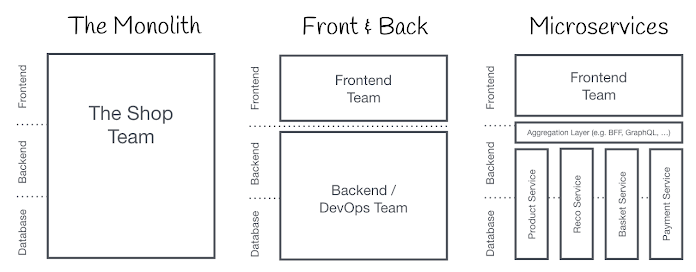
  What are Micro Frontends? The term  Micro Frontends  first came up in ThoughtWorks Technology Radar at the end of 2016. It extends the concepts of micro services to the frontend world. The current trend is to build a feature-rich and powerful browser application, aka single page app, which sits on top of a micro service architecture. Over time the frontend layer, often developed by a separate team, grows and gets more difficult to maintain. That’s what we call a  Frontend Monolith . The idea behind Micro Frontends is to think about a website or web app as  a composition of features  which are owned by  independent teams . Each team has a  distinct area of business  or  mission  it cares about and specialises in. A team is  cross functional  and develops its features  end-to-end , from database to user interface. However, this idea is not new. It has a lot in common with the  Self-contained Syste...

Android 15: mobile operating system

Image
  Google's next major Android update, Android 15 (Vanilla Ice Cream), is expected in May 2024. It brings new features like native satellite connectivity, high-quality webcam mode for PCs, and improved optimisation for foldable phones.   Google releases a new major update to Android every year, its operating system that powers the world’s most popular smartphones from the biggest brands. This year, the search engine giant will likely launch Android 15 alongside new hardware at  Google I/O 2024  on May 14. Going by the current trend,  Android 15  will bring a ton of new features, with many powered by Generative Artificial Intelligence. Here are 10 new features that Google is introducing with the Android 15 release. 01 Android 15: A new name and logo Android 15 will be the name of the next major Android OS release, which comes with a new logo inspired by space and rockets, similar to the Android 14 logo. Android 15 is internally known as Vanilla Ice C...

Quantum computing

Image
Introduction  Quantum computing is a multidisciplinary field comprising aspects of computer science, physics, and mathematics that utilizes quantum mechanics to solve complex problems faster than on classical computers. advantage of quantum computing : 1. CHEMICAL SIMULATION In the field of chemical simulation, quantum computing has the potential to vastly improve the process and bring several benefits Scientists could possibly explore larger and more complex molecular structures using this increased computational power, allowing them to achieve more accurate and detailed simulations of chemical systems due to the exponential complexity of the quantum world, which classical computers have difficulty simulating accurately. 2. OPTIMIZATION As a result of quantum technology, route planning and logistics are also being transformed. Using quantum computers could help reduce freight transportation costs and boost customer satisfaction significantly by supporting global routin...

AI in Edge Computing

Image
Introduction to AI and Edge Computing The rapid rise of the applications powered by  Artificial Intelligence  raises the data center's technical requirements, which generates high costs. The cloud is not a valid alternative in many cases. In these cases, the best option may be edge computing, which can provide the necessary computing power and minimize service delivery latency. Therefore it is necessary to Bringing AI into Edge Computing. What is Edge AI? Edge AI is the combination of Edge computing and Artificial Intelligence. With Edge AI, AI algorithms are executed locally on a hardware device using the data collected from Edge computing. As the data is collected and processed in real-time, it reduces power consumption as well as data costs since the device doesn't need to be connected to the internet at all times. Edge computing brings processing, computation, and data storage closer to where it is generated and collected instead of relying on moving it to a remote locatio...

DevOps

Image
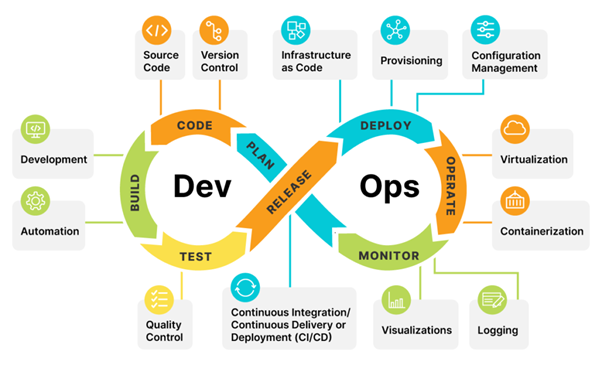
  DevOps DevOps is  the combination of cultural philosophies, practices, and tools that increases an organization's ability to deliver applications and services at high velocity : evolving and improving products at a faster pace than organizations using traditional software development and infrastructure management processes. DevOps focuses on breaking down traditional silos between development and operations, enabling a more seamless and iterative approach to software development. Some key principles and practices of DevOps include: Continuous Integration (CI): Developers frequently integrate their code changes into a shared repository. Automated tests and code analysis are executed to catch integration issues early. Continuous Delivery (CD): Automated deployment pipelines ensure that code changes are tested, validated, and ready for production deployment at any point in time. This includes automated testing, building, and packaging of software. Infrastructure a...

AI tools for the classroom

Image
  AI tools for the classroom What is artificial intelligence? Artificial intelligence (AI) refers to the ability of a computer or machine to perform tasks that would normally require human intelligence, such as learning, problem-solving, decision-making, and more. There are several different approaches to building AI systems, including machine learning, where a system is trained on a dataset and can improve its performance over time, and rule-based systems, where the system follows a set of predetermined rules to make decisions.  AI can be applied to a wide range of areas, including natural language processing, image and video recognition, robotics, and more. The goal of AI research is to create systems that can perform tasks at least as well as, or ideally better than, humans. AI has the potential to revolutionize many industries and transform the way we live and work, but it also raises important ethical and social questions. source: https://ditchthattextbook.com/wp-con...